22 March 2011

Patrick Howlett


Can you briefly describe what you do?

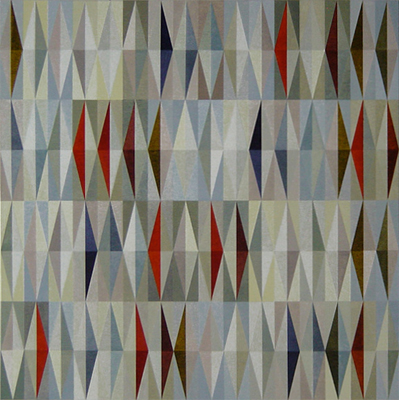
I make paintings that I hope are novel in some way. I like the transformative nature of making a painting, and I am conscious of that idea when creating an image. I mostly make watercolours and temperas but I also experiment with gesso and stain on plywood.

What drives you to make work?

I would say it is a combination of the experience of seeing other painting and the experience of making work myself. Both are very rewarding activities for the most part. I get a lot out of looking at other art, but then I get something different from working in the studio - it generates new ideas and approaches that I would not have had otherwise. Surely there are other things too, some deeper, some more shallow. 

Can you tell me something of your day-to-day working practices?

Day to day can really vary. It depends on what else I am doing, deadlines or lack thereof. I make my own gesso and egg tempera paint. The process can be a lot of labour and so I break it up into stages. I might be preparing a group of panels for a month or I might be working on a group of paintings or I might be reading and working on the computer. I like to be trying different things at the same time and generally I really like to sit with work for a while. I feel more than ever the need for a studio routine that can fend off other demands. If I am away from the studio for too long I can get a little lost, but on the other hand it can also help to have new approaches, because you sort of forget where you were.

How long have you been working in that way?

The last five years. It probably changed after I taught full-time for a few years. On the other hand, it's probably more similar to how I've always worked than it is different.

Which artists have had the greatest affect on your work?

This is actually a really hard question. Early on some painters that really interested me would have been Paul Klee, David Milne, Georgio Morandi, Philip Guston. More recently, what I was doing led me to look at particular artists such as Jean & Sophie Tauber-Arp, the Vorticists, Arthur Dove, Lawren Harris, Bertram Brooker, and Joseph and Annie Albers. In thinking about series of works and processes I have looked a lot at Sol Lewitt, Blinky Palermo, Robert Mangold, and Richard Tuttle.      

What, outside visual art, informs your practice?

Literature, philosophy and writing in general are important for me. They have suggested a lot of content, and influence ways that I approach making the work. For recent work I have been reading Henri Bergson. Music is really important too, for thinking through visual problems I often think of music - mostly because I really like working with it and it is almost always on. I was really into dance, but I haven't seen much of late. The internet and photoshop have also played a part. Oh, and cooking too.

How would you like people to engage with your work?

It don't really have an interest in prescribing how people should be looking. It is just nice if they take the time to look. I definitely appreciate that. I hope people can enjoy painting in way similar to how they might listen to music.

Have you seen anything recently that has made an impression?

I have seen a couple of Robert Mangold exhibits that really made me think about his work more: work from the mid-80's and more recent stuff.  I've run into a few Lara Owens paintings that were really charismatic. Also, a couple of shows by Amy Sillman that I keep thinking about. Last time I was in Berlin I was blown away by the hanging of two Chardin's on either side of a Watteau at the Gemäldegalerie. The Brice Marden retrospective a few years ago really surprised me and left an impression. There was a Thomas Nozkowski show last year at the National Gallery of Canada that was really great to see.

Do you have anything exciting on the horizon?

The horizon is exciting. 

21 March 2011

Vincent Hawkins


Can you briefly describe what you do?

I paint and draw with acrylic on canvas, cardboard and paper, and recently have begun making 3 dimensional pieces. I work in an improvisational way, never knowing from the outset how anything will turn out. At the moment I am pursuing a line of enquiry that goes against how I have set about working before.  A little dissatisfied with way the canvas "frames" or "windows", I am becoming more interested in the forms I produce as objects in their own right, bringing them into the immediate environment. It may be more a sculptor's sensibility but I still see it as painting. 

What drives you to make work?

 "What is painting?" would be one answer to that question. I seem to be not able to stop making work. Perhaps it comes out of the fact that it’s an activity on one's own terms, the one thing you might be able to control in life. It doesn't really matter if nobody likes what you do; it’s more the development of a "dialogue" and therein lays its success if that is what is happening, as I see it.

 There is a passage in the catalogue from the Late Braque exhibition that was on at  The Royal Academy at the end of the 90's  which has been quite influential for me; "The painted space can receive everything at once; past, present, future.  It can dilate and unroll into infinitesimal mental convolutions, or, alternatively, it can withdraw into the barest description". It suggests you can approach painting from opposite ends. I thought it was insightful and it appealed to me for its strength of possibilities to explore further. So what were, for me, rather image laden paintings of a couple of years ago, began to change and be more pared back, reducing.... to the point of liberating forms out of the paintings and into the world.

Can you tell me something of your day-to-day working practices?

I am working with primed cardboard boxes, on to which I draw, then cut out forms, and paint with acrylic colour, then pinning them to the studio wall with thumb tacks - adding and subtracting as I go along. This is how a piece develops. I may cut them up and repaint them. Play is part of the process, it’s where you discover through a kind of excavation. I move the forms around and reconfigure them, if needed. It is like drawing with physical forms in order to build structures: A very open and satisfying way of working. I am also looking around for other materials to use so it is not confined to cardboard, only. I enjoy the weights and measures of forms, colours and the different kinds of "energies" in painting, its state of flux, where they haven't committed themselves to description yet.

How long have you been working in that way? 

 The card board pieces have been a recent thing, within the last few months. I had been experimenting with folded drawings, and this has developed out of it. It links back to collage work I was making a few years ago, another part of what seems a continuous cycle of stuff returning having picked up further detritus along the way. There is something of the fragility in the cardboard that appeals. The impermanent, falling away, failing, deteriorating.

Which artists have had the greatest affect on your work?

Richard Diebenkorn, Kurt Schwitters, Guston, Motherwell and Peter Kinley, Roger Hilton, Paul Nash. Titian, Goya. Picasso. Tom Nozkowski, there are many.
There are two paintings in The Picasso Museum in Paris, head studies from 1907, from the time of Les Demoiselles d'Avignon, that have been pivotal by seeing close up. There is evidence in the respective paintings of previous workings, he just re-used the canvases, I suspect, and painted anew over what was there. Whited over and used again. This under-painting, for me acts as a kind of armature onto which the newer forms are attached like a palimpsest . It reminded me of what I enjoyed about collage that it’s possible to still keep what you have seemingly destroyed for further inclusion in the work. Seeing these pieces helped to resolve some technical problems for me, to do with opacity and translucency, of editing and inclusion of motif, what to keep - what to let go of; ideas which I feel I have absorbed as a result. 

What, outside visual art, informs your practice?

Difficult to say as so much is visual. I am not that well read, but I enjoy poetry… it’s something that is helpful to me along with music. Some people have said how they think there is a sense of lyricism and musicality in my work. I do actually enjoy the ballet and modern dance, I find it quite inspirational. I am sure it’s to do with form, rhythm, movement, energy.
  
How would you like people to engage with your work?

They should bring something of their own experiences to art. I reject having everything worked out for you, pretending there are "answers".
Uncertainty and doubt are painting's life blood. Art is not science, although science may be part of it. It’s the realm of the perceptions and you need different antennae when looking at or "reading" paintings.

 Have you seen anything recently that has made an impression?

 Writer Jeanette Winterson from an article in The Guardian Newspaper in 2002, which I saw only recently - She wrote about Art and its relationship to the corporate world. There are some real goodies in the piece. How these two worlds are diametrically opposed, she said "it may be that capitalism will be as successful with art as it has been with religion, absorbing it to the point of neutrality." 

Do you have anything exciting on the horizon?

 A group show in May which I am looking forward to and I am scheduled to curate a drawing show next February at the Herbert Reed Gallery in Canterbury, all being well! And I have begun a kind of art on paper exchange, swapping art for art, which actually is something else Jeanette Winterson says in the article about the importance of the energy of art for art. If money ceased to exist, people would still make art.

13 March 2011

Julian Wakelin


Can you briefly describe what you do?

I make oil paintings on canvas, sometimes on board, and I also make drawings.

What drives you to make work?

I’m interested to see how a painting’s going to turn out, and while I’m away from the studio I will have thoughts and ideas that may feed into what I’m presently making - so this keeps me coming back to the studio to try and see if what I had only imagined or briefly sketched out could in actuality fit in with what I am currently working on.

Can you tell me something of your day-to-day working practices?

I get to the studio early. I tidy up – it generally having got into a mess after the last working session – this is a tactic I employ to get me into doing some actual work because it involves moving around the numerous small paintings that I have on the go allowing me to make connections between various images and to kick start making decisions about what I may or may not do to each piece. The actual act of painting itself is one of trial and error – of addition and removal – an open-endedness whereby I can ask questions about the act of painting itself.

How long have you been working in that way?

I’ve been working this way for about the last 8 years. Before that I was making quite large paintings but came to realise my realise that my approach to making paintings is experimental and varied, so practically it made sense to start working on a smaller scale, say on 10 or 12 canvasses on which I could try out a variety of ideas and approaches.

Which artists have had the greatest affect on your work?

As a 17 year old working weekends at a gallery in Harrogate, we put on a show of Basil Beattie’s huge physical abstract paintings. I remember them coming in rolled up and the smell of the paint filling the room as he unfurled them and put them on to stretchers. I know that this had a profound effect on me wanting to make paintings. Other artists that I have admired and continue to do so are Raoul de Keyser, Walter Swennen, Philip Guston, Mary Heilman and Prunella Clough.

What, outside visual art, informs your practice?

Walking and running somehow inform my practice. These give me the time to think clearly about what I might be struggling with in the studio. Bus rides can be good too.

How would you like people to engage with your work?

Slowly and patiently.

Have you seen anything recently that has made an impression?

A show I’ve seen recently was Simon Callery’s new work at Fold Space - it had a real handmade quality to it, stark and serious which I enjoyed very much. Also Walter Swennen at Domo Baal was extremely refreshing.

Do you have anything exciting on the horizon?

I’m in a group painting show at 402 Gallery in May, another group painting show at Charlie Dutton’s in June, and also at APT in October. And the artist Ross Hansen has curated and put together a small catalogue of my paintings which will be self published this month.

06 March 2011

Katrina Blannin


Can you briefly describe what you do?

Perhaps my work is closest to constructivism; gradually moving towards to a more systematic approach as time goes by. Within the ‘frame’ or ‘window’ of the canvas (piece of paper…..) I am searching for the best possible composition or arrangement of elements: balance – a truth, or simplicity. My paintings are initially planned quite carefully, with a starting point of a grid: the geometry is basic. However, sometimes change en route is necessary usually with regard to tone or colour nuance. Sometimes I discover new things through the process and slightly shift the approach. Recently the painted shapes have been applied in acrylic glazes – many layered/thick or left just thin and the material quality of the linen is allowed to play its part for tone. I have also found a way to make watercolours by cutting up the paper into shapes, painting them and then reassembling them like a jigsaw: I like this constructivist approach, which can be repeated. I am also constantly thinking about colour/tone: reaction, interaction and design: resonance and dissonance.

What drives you to make work?

The painting itself drives me along every day, every week. There is so much to do and often not enough time. The next step is important. (I was also thinking that it’s a bit like working in a dark room developing black and white prints and watching the images appear in the tray – after all that preparation it’s still always exciting to see the finished work – never quite what you imagined)

Can you tell me something of your day-to-day working practices?

The good times are when I have no distractions (life) and I can just get on in a disciplined way. My studio is small but easy to get to and I make sure I have efficiently set it up with everything I need. In this chaotic world I depend on routine  - and if no one is around good music and time to think. When I am not teaching (part time) I am in the studio a few days a week. I have organised my practice so I can always pick up where I left off – pretty much.

How long have you been working in that way?

For about ten years. Before that I used to work hard but in a much more expressionistic, spontaneous, figurative way without as much preparation or planning and I think I disappointed myself too often with the final results. I am more often content that I am making progress now. When I finished my MA I went through a transition period and discovered that painting itself is beautiful and inspiring and has a fantastic language of its own – I didn’t want to be concerned anymore with what it was ‘about’. I became less concerned with narrative. I suppose I am interested in the abstract as a universal language.

Which artists have had the greatest affect on your work?

Over the last few years M Martin, K Martin, Heath, Hill, Wise et al (see Constructed Abstract Art in England by Grieve). The De Stijl movement: Von Doesburg/Mondrian. Scandinavian Concrete eg. Ib Gertsen. Robyn Denny, Maija Isola (Marimekko), Jeremy Moon, Sonia Delaunay, Paul Nash, Jeffrey Steele, Anni Albers. Josef Albers, Walker Evans, Niki de Saint Phalle, Ben Nicholson, Sybille Berger and more. And anything in the National Gallery.

(In her essay, ‘The Writings of Mary Martin’ 1990, Hilary Lane discusses Mary Martin’s idea that all ‘words’ or information needed to describe the artworks should be embedded in the work itself; that written language cannot always express or explain the processes and decisions made during their construction. Mary Martin wanted the story of how her work was made to be clear to the person when looking at it. And although proportion, rhythm and measurement were key she wanted to emphasise the unexpected and a need to remain inventive. Of the process of construction itself Martin wrote that it is: ‘a thinking making process, not necessarily in three dimensions. Internal logic is the key. The success of such a process is wholly dependent on a right choice of symbols. The choice is based on intuition and experience.’)

What, outside visual art, informs your practice?

The North Norfolk coast, swimming outside: sea/lidos, walking, plants, quilting, stained glass windows, buildings, music, film….

How would you like people to engage with your work?

I am not sure. Perhaps with some knowledge of art. I know I wish my art history education had been better.

Have you seen anything recently that has made an impression?

I was lucky enough to go to a cold grey Paris recently: it was lit up by the small stained glass windows in the shape of sunbursts and crosses in the tombs of the Pere Lachaise cemetery, Theo Von Doesburg’s stained glass windows in the Pompidou show and the windows of the Notre Dame.

Do you have anything exciting on the horizon?

Arranging a group show at Charlie Dutton Gallery.


15 February 2011

Patrick Michael Fitzgerald


Can you briefly describe what you do?

I am a painter. I use mostly conventional painting materials – oil paint on
canvas primarily. More recently, I have been using collage on my paintings as well; bits of cut canvas, cloth or paper. My working process is quite organic and I like the materiality and directness of painting. Each painting is a kind of entity or body, they are layered and grow in unexpected ways, they are meshed and woven together using different painterly components, small gestures and marks, threads and lines, swathes and bands. I like the idea of cultivation and gardens and the paintings often refer to these directly or indirectly. Obviously, colour, light and form are essential elements in my work but also the qualities of surface, tactility and touch are very important too. I have come to understand that painting is as much about energy as anything else, nothing is really solid and finally formed. I have always made drawings too and they have equal value to my paintings. The paintings feed into the drawings and the drawings feed into the paintings in equal measure.

What drives you to make work?

I think it probably comes from a need to bear a different kind of relationship towards so-called reality. A reality - which perhaps due to my own character traits - I frequently cannot help feeling disappointed or even disgusted by. One does everything despite onself, what at first might seem like an escape from reality, is not really an escape at all, but rather, over the years, the slow formation of a new relationship to reality and being, one that is more intense and free. On one level (and thinking of Kierkegaard) what I do is like marking the stages on life's way, hopefully with a certain grace. It is do with time and recognising one's inevitable passing.

Can you tell me something of your day-to-day working practices?

I walk to my studio in the morning and spend most of the day there.
I always have a number of paintings and drawings on the go at the same time.
I probably spend more time in the studio looking and thinking than physically working. The physical interventions are often quite quick though works can take a long time to make. My decisions are often governed by what could be loosely described as a kind of negative theology; I act in relation to what I do not want to do, to what I want to avoid doing. Essentially, this is just a tactic I have adopted to be able to deal with risk and failure.

How long have you been working in that way?

For a few years. My earlier work was more varied in its use of supports and perhaps more hermetic. I would often make wooden box-like structures that projected from the wall but they always had a very obvious front plane and were to be looked at and considered as paintings. They tended to be objects lost in the world. Now the paintings have more of an inward quality and are lost in themselves.

Which artists have had the greatest affect on your work?

There are many but I should mention Pierre Bonnard, Raoul de Keyser, Edvard Munch, Piet Mondrian…

What, outside visual art, informs your practice?

Anything, potentially, especially the stuff of my immediate everyday life, though it's often difficult to explain how it’s all filtered and transformed into something new as a painting; things remembered, the pattern on a summer dress, shadows on a path, trees (always trees), the profile of someone leaning against a bar, fragments of newspaper photographs, the corner of a room, someones face...

Music is very important for me, and certain kinds of cinema as well; Robert Bresson for example.  I’m always reading something too, bits of poetry, aphoristic writings, philosophical reflections, short stories , history….the newspaper!

How would you like people to engage with your work?

No matter how isolated and introspective life in the studio might be, it is difficult to imagine a painting ever being fully realised without an understanding audience for it. Everytime a viewer stands before a painting, he or she creates it anew with their gaze and through their direct experience of it. This is one reason why painting is fragile because after a certain point it always depends on someone else.

Have you seen anything recently that has made an impression?

Paintings by the Argentinian artist Varda Caivano, the Rene Daniels exhibition at the Camden Arts Center in London a few months ago, a viewing of Samuel Beckett’s “Film” which was part of the Moderns exhibition at the Irish Museum of Modern Art and though not something seen but rather something read, a wonderful short story by Robert Walser called “The Walk”.

Do you have anything exciting on the horizon?

The paintings that I’m currently working on are always the most exciting thing for me. But other than that, one of my recent larger paintings will be on show for the first time at the Irish Museum of Modern Art in May. I will also be showing some new drawings at the Drawing Now art fair in Paris this March and also in March a book launch for a recent publication about my work will take place at Rubicon Gallery in Dublin.

03 February 2011

David Aylsworth


Can you briefly describe what you do?

I make paintings.  Mostly they are paintings of a small number of simple shapes in pretty simple colors that have some sort of relationship to each other.

What drives you to make work?

Going into the studio day after day is not a lot of fun until I have found the spark that interests me in a particular painting.  Once that has taken hold, there are few greater satisfactions I get from just about any other activity in my life, and I can't wait to get back to working on a particular painting and seeing it to completion.

Can you tell me something of your day-to-day working practices?

I put down a whole lot of streaks, shapes, and gestures of paint in various colors and configurations until something catches my interest enough to focus in more intently.  Until that time, I usually have eight to ten canvases of various sizes going at the same time, and I will go from canvas to canvas with a can of paint, making marks of no particular relevance on each one.  Once I get interested in a particular one, I usually abandon all but that one for the duration until it is finished.  Then I dab and daub paint on the rest until I get interested again.  The absolute worst time is when I have a room full of white canvases, but I rarely am organized enough to get a new one prepared once I finish one and have 7 others in the pubescent stage.  Once I think I have finished one, I am on such a high, I just want to continue bringing the others up to that same level.
My painting at the start is hugely gestural and expressionistic with a lot of goopy paint and sometimes disgusting colors until I think I see something going on that points to a direction.  Lately, these directions get pretty hard-edged (or, as hard-edged as I can get without measuring or taping off areas) and the shapes get pretty angular as they point, prod, and run away from each other.  I have this nascent belief that if I feel out a straight line on a shape, and paint it as sharply and cleanly as I can with my not terribly steady hand, that something more is transmitted through that process than if I measured and taped off the same line and shape.  It's that something more that I can't really define for myself yet.  Maybe it's something that I don't want to define for fear that once defined, it won't interest me anymore.

How long have you been working in that way?

For my final project in school, I did a lazy version of geometric abstraction, but that seemed to lose relevance for me once I moved to Texas twenty years ago, so I started painting more gesturally and expressionistically, with a dash of goofy balloon animal type forms floating in and out of the slapdash paint.  Letting the gestural layers become more angular and giving in to my desire to see flat and filled in painted shapes has been a pretty recent thing--probably in the past three or four years.

Which artists have had the greatest affect on your work?

I guess you always think of the people who you've been thinking about most recently, don't you?  Recently I haven't been able to get a particular painting by George Braque out of my mind.  For clunky, socially awkward but distinctive shapes with personality, I think of people like Thomas Nozkowski, Arthur Dove, John Marin, Esphyr Slobodkina, Charles Burchfield, and Marsden Hartley.  For sheer beauty and awe-inspiring painting, I love looking at Elizabeth Murray, Georgia O'Keeffe, Lawren Harris, Rockwell Kent, Grant Wood

What, outside visual art, informs your practice?

Music.  Predominantly Broadway show style music, but recently a good deal of jazz and slowly a bit of grand opera.

How would you like people to engage with your work?

You always want to make something that is intriguing to look at.  I would hope that people would look at the shapes and how they interact as practically living and breathing beings that have a quirky existence that mirrors their own.  Most of my paintings are titled after some inner rhyme or line in a show tune lyric, and I always fantasize that someone as geeky as me about showtunes will see a painting, recognize the lyric, and have the song stuck in their head as a soundtrack while they look at the painting.  I don't think it ever really happens like that, but it is what I fantasize about the ideal viewer of my paintings...

Have you seen anything recently that has made an impression?

About a year ago, I saw an exhibition at the Peabody-Essex Museum in Salem, Massachusetts of paintings, drawings, and photographs by people who had made expeditions to Antarctica.  Lawren Harris, Rockwell Kent, Frederic Church and the like.  Everything was figurative, but maybe because of the majesty of icebergs and aurora boreali, the figuration often came remarkably close to abstraction.  I really got into the airtight, frozen and silent gravity and spiritual splendor of just about everything I saw there, and I've been trying (rather unsuccessfully) to bring those feelings into my own paintings back in my studio.  Maybe it's the activity of painting itself that distracts me from that feeling of wonder and awe... when I'm moving around, flinging paint, or fixating on straightening a line, it's hard to sit back and be awestruck... but I guess that's almost getting back to your question about "what drives you to work?", isn't it?

Do you have anything exciting on the horizon?

Talking with you here has been the most exciting thing on my horizon in a long time!  Aside from THAT, you mean?  I was lucky enough to get a grant last year from the Artadia organization, so I will be having work in a group show of grant awardees in Chicago later this year.  I've never shown any paintings in Chicago before, and I like the city a whole lot, so that should be fun.  I'm also lucky to work with two galleries in Texas--I had a show with the Holly Johnson Gallery in Dallas last May, and am just starting to talk with having another with Inman Gallery in Houston sometime in 2012.
But, probably the MOST exciting thing for me is that after about two seemingly endless weeks of mucking paint around blindly and stupidly, I just started getting a glimmer of something that I think might lead somewhere this morning.  It's such a relief to actually feel excited about going back to the studio!

02 February 2011

Emma Biggs & Matthew Collings


Can you briefly describe what you do?

Paint abstract paintings that have a lot of content to do with the following - how things in the world actually look; colour relationships; the way light works, and the fact that colour is light; finding convincing visual metaphors in an improvised abstract language for the way perception of tone affects form, as in graded tones on a body or a bit of architecture (etc); the way in which nature is perceived, even if its often unconsciously, to be structured and patterned, and the way that visual traditions built up over centuries (in all sorts of different types of art) are really about finding and refinding metaphors for that sense of structure and pattern.  

What drives you to make work?

Optimism, seriousness, interest in history. 

Can you tell me something of your day-to-day working practices?

Emma Biggs conceives the colour relationships and mixes the colours; Matthew Collings does the actual painting.  Within that framework, which is fairly rigid, the practice is extremely improvisatory.  There are no systems or preplanning.  A few relationships are set up, then some more, then some more, etc.  Most of the work is adjusting and altering. 

How long have you been working in that way?

We have been working together and exhibiting as a duo for just over ten years. 

Which artists have had the greatest affect on your work?

A collection of works in the maritime museum in Venice which are thank yous for people whose lives have been saved at sea.  They are mostly mid tones, because they're sea scenes, and then there will be certain accents or surprises, for example, a black boat.  Or there night be a little depiction of a Madonna or a symbolic representation of the number of souls saved at sea -- and these are likely to be in a much more brilliant colour. 

What, outside visual art, informs your practice?

Nature, textiles, movies, ceramics.
 
How would you like people to engage with your work?

Any way they want.  Look at it, we guess! 

Have you seen anything recently that has made an impression?

Richard Wentworth's film in "Modern British Sculpture" and the ancient Egyptian carving of a baboon at the beginning of that show.  

Do you have anything exciting on the horizon?

Our next show at the Fine Art Society, Bond Street, London, at the end of this year (2011).